Every trader runs a feedback loop. Take a trade, see the result, adjust, repeat. The loop is supposed to compound into skill — and for a small number of traders it does. For most, it compounds into something else: a set of habits selected by which trades happened to pay, not by which decisions were actually good.
The problem: P&L is a noisy teacher
A trade's outcome is the product of two inputs: the quality of the decision and the variance of the market between entry and exit. The trader controls the first. The second is noise — and over any small number of trades, the noise is louder.
This would be harmless if the two inputs were easy to tell apart after the fact. They are not. A winning trade feels like a good decision. A losing trade feels like a mistake. Poker players have a name for judging decisions this way — resulting — and the concept transfers to trading without modification: the result is the least reliable witness to the quality of the decision that produced it.
The failure modes come in two symmetric forms:
- The lucky win. The entry was forced, the claimed setup was not actually present, the stop was arbitrary — and the market paid anyway. The payout registers as confirmation. The habit is now stronger than before the trade.
- The punished good call. The setup was valid, the execution followed the plan, the stop was structural — and price took it out before moving as expected. The loss registers as error. The trader adjusts away from a correct process.
Run this loop a few hundred times and the result is not randomness — it is systematic miseducation. The trader has been trained by variance.
A terrible call that wins and a great call that loses both teach the wrong lesson. The scoreboard cannot tell you which trader you were today.
How traders evaluate themselves today
Most self-evaluation in retail and prop trading runs through some combination of four methods. Each has real value; none can separate decision quality from outcome on its own.
| Method | What it actually measures | Where it goes blind |
|---|---|---|
| P&L / equity curve | Aggregate outcome of decisions and variance | Cannot attribute results to skill vs. luck; small samples dominated by noise |
| Win rate | Frequency of positive outcomes | Says nothing about whether wins came from the plan; punishes correct low-frequency, high-payoff styles |
| Trading journal | What you did, plus how you felt about it | Self-assessed after the outcome is known — outcome bias is built into the moment of reflection |
| Screenshot / mentor review | Setup recognition on marked-up charts | Almost always reviewed with the outcome visible; hindsight contaminates the judgment |
The pattern across all four: evaluation happens after the outcome is known, and the outcome contaminates the evaluation. A journal entry written after a stop-out reads differently than the same entry written after a winner — for the same decision.
The audit nobody runs
There is a second, quieter gap. Traders review their losses — that discipline is widely taught. Almost nobody audits their winners. A winning trade generates no pain, invites no scrutiny, and files itself under skill by default. But the winner pile is exactly where lucky, off-plan entries hide, because nothing about a payout asks to be examined. Over time the loss pile gets cleaner while the win pile quietly accumulates unexamined habits.
Where outcome-based review breaks down
Pulling the threads together, outcome-based self-evaluation fails for four structural reasons:
- Attribution is impossible trade-by-trade. One outcome cannot be decomposed into skill and variance. Only the decision itself can be graded at that resolution.
- Samples are too small for the statistics to rescue you. Aggregates like win rate and expectancy do eventually converge on the truth — over sample sizes far larger than the window most traders use to judge themselves. The feedback you need this week cannot come from the law of large numbers.
- Hindsight rewrites the question. Once you have seen the outcome, you can no longer honestly reconstruct what you knew at entry. Marked-up review of a chart whose ending you know is a different cognitive task from making the call blind.
- Incentive structures amplify it. A prop-firm evaluation is a small-sample pass/fail filter with a fee attached. It is possible to pass one on luck and fail one on variance while trading well. The trader who passed on luck carries unexamined habits into a funded account with real drawdown rules — the most expensive possible place to discover them.
What decision-quality grading measures instead
Definition. Decision-quality grading evaluates a trade call using only two inputs: the information that existed at the moment the call was committed, and what the market subsequently revealed. It scores the call's components — setup validity, entry location, stop placement, target logic — against chart-derived facts, never against the trade's monetary result.
Concretely, a graded call decomposes into questions that have objective answers:
- Was the claimed structure present? The fair value gap, order block, or liquidity sweep the call was premised on either exists in the candle data by strict definition, or it does not.
- Was the entry located where the plan required? Distance between the committed entry and the relevant structural level is measurable.
- Did the stop sit beyond invalidation? A stop inside the structure that would invalidate the idea is a graded flaw even when it never gets hit.
- Was the target consistent with the draw? A target beyond the opposing structure the setup implies is a different quality of decision than one placed arbitrarily.
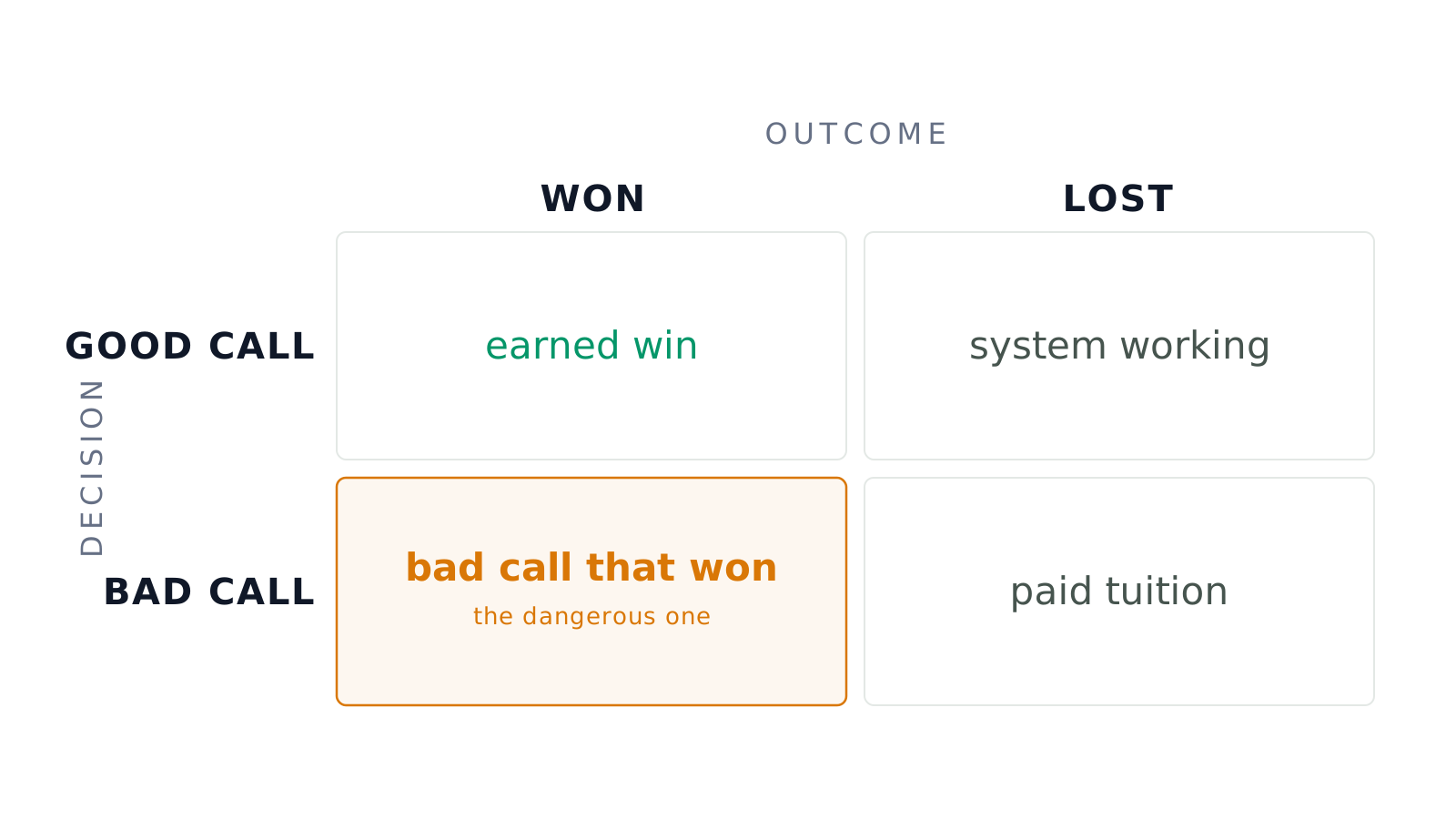
Two properties make this framework work where outcome review fails. First, every component is checkable from chart data alone — no self-assessment, no memory of intent, no outcome in the loop. Second, it produces a two-axis result: decision score and outcome, reported separately. The four quadrants — good call that won, good call that lost, bad call that lost, and the dangerous one, bad call that won — each teach a different lesson, and only a two-axis report can tell them apart.
What an AI-assisted decision-review workflow looks like
None of the above requires artificial intelligence. It requires something rarer: a review protocol that hides the future at decision time and applies fixed definitions at grading time. The honest role of AI is narrow and late in the pipeline.
A workflow with the right shape, tool-agnostic:
- Freeze. Present a historical chart truncated at a moment. The reviewer sees exactly what a trader at that moment saw — nothing after.
- Commit. Record a complete, falsifiable call: direction, entry, stop, target. Once committed, it cannot be edited. This single constraint eliminates hindsight bias structurally rather than through willpower.
- Reveal. Play the chart forward. The market's actual path is the ground truth — not an opinion, not a model output.
- Grade deterministically. Compare the committed call against the revealed truth using fixed, mathematical definitions of the structures involved. The same call against the same data must produce the same grade, every time.
- Translate. Only here does AI earn its place: turning a deterministic grade into plain-language review — what the call got right, what it missed, and what pattern is emerging across your graded history. The AI explains the verdict; it never renders it.
How Tradexis implements it
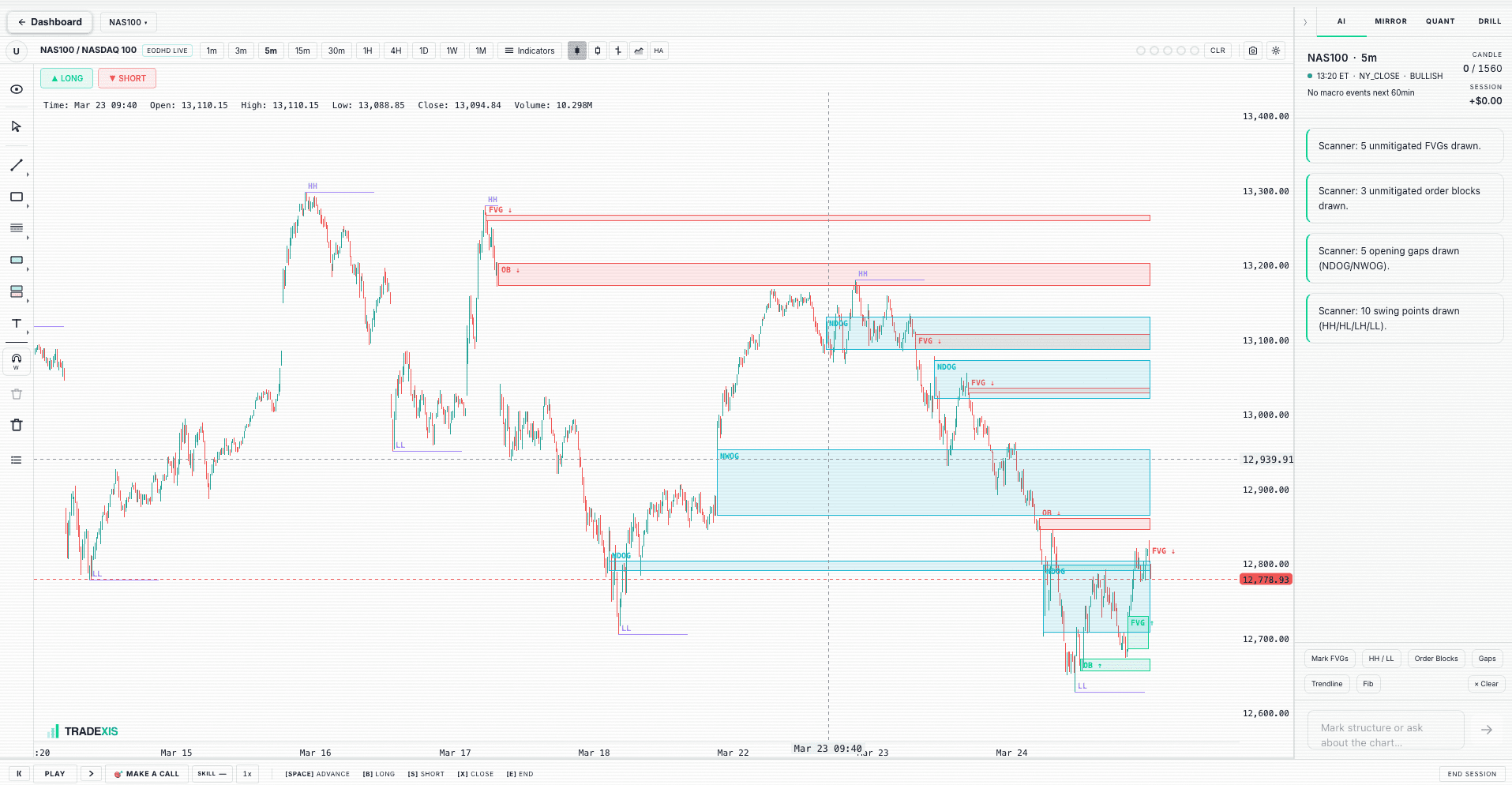
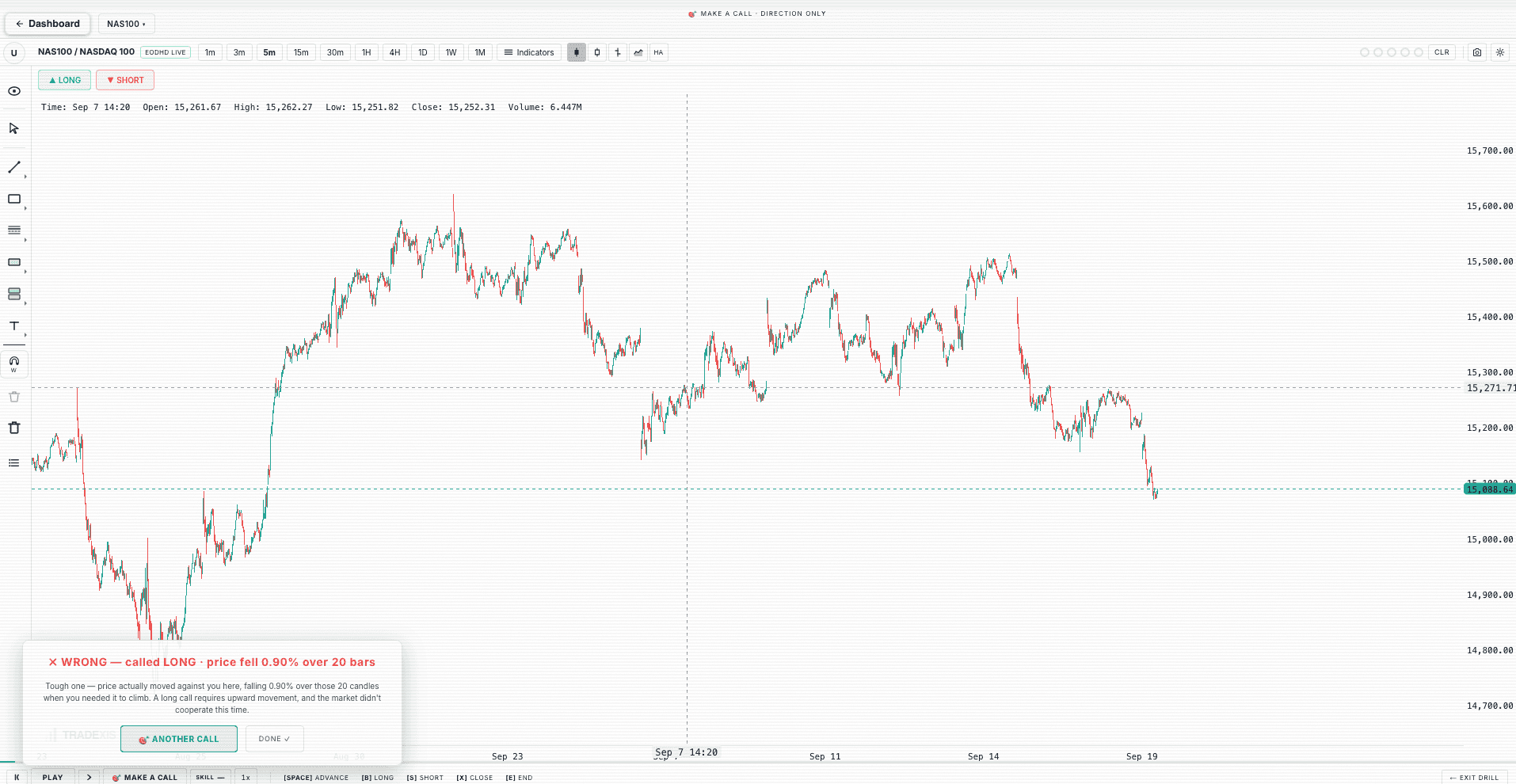
Tradexis is a practice simulator built around exactly the five steps above. A historical chart is frozen at a moment; you make a blind call — direction, entry, stop, target; the chart plays forward; a deterministic engine grades the gap between your call and what the market actually did.
The division of labor is strict by design. Structure detection — fair value gaps, order blocks, liquidity sweeps, opening gaps, market structure shifts — is pure math over candle data, with fixed definitions. The played-forward chart is the only source of truth. The AI's sole job is translating the graded result into review you can act on, and surfacing patterns across your session history. It never predicts, never signals, never overrides the math.
Grading decision quality separately from outcome is not a feature of the product so much as the reason it exists: the two-axis result — how good was the call × how did it go — is the report card the P&L cannot produce.
Key Observations
- Outcome and decision quality diverge constantly at the single-trade level. That divergence — not trader laziness — is why self-taught feedback loops so often train the wrong habits.
- Winners need auditing more than losers. Loss review is standard discipline; the unexamined win is where degradation hides. A two-axis grade makes the bad-call-that-won quadrant visible for the first time.
- Blind commitment is the mechanism, not the AI. Hindsight bias is defeated by hiding the future at decision time — a structural fix, available to anyone with a replay tool and the discipline not to peek. AI makes the review cheaper and more consistent; it does not make it honest. The commitment step does.
- Determinism is what makes grades trustworthy. A grade you can argue with is an opinion. A grade recomputable by anyone from the same candle data is a measurement. Keeping AI out of the judging seat is what keeps the measurement clean.
- Decision grading works at n = 1. Statistical measures need samples that most traders never patiently accumulate. A graded call gives real feedback on the first trade — which is also why it is the right preparation for small-sample, pass/fail environments like prop evaluations.
Related reading: what a structured trading journal should log, fair value gaps, defined strictly, and how prop-firm evaluations actually filter traders.